
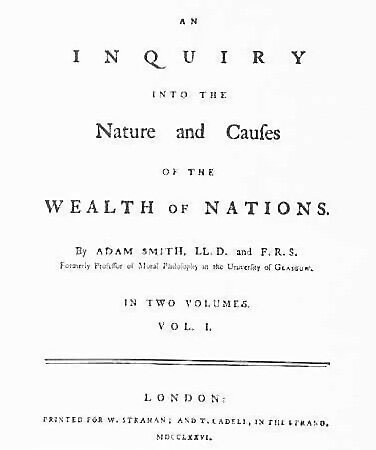
Adam Smith (1723–1790), often known as the “founding father of economics,” was, in fact, a moral philosopher who placed a high value on liberty and moral rectitude. His famous treatise on The Wealth of Nations (1776) was preceded by The Theory of Moral Sentiments (1759). Smith was not just interested in efficient resource allocation. He adhered to the principle of nonintervention and was a firm adherent of free trade (laissez-faire). Like other classical liberals, he was interested in the institutions necessary for creating a harmonious social order, and he found the key to be a “simple system of natural liberty”—supported by a just rule of law protecting persons and property. His ideas are to be celebrated along with the 250th anniversary of the Declaration of Independence.
Adam Smith’s Invisible Hand Doctrine
Although Smith only used the term “invisible hand” once in his Wealth of Nations (WN), it is by far the most widely cited term from that book. He held that individuals are self-interested, and that, in pursuing their interests—within a system supporting liberalism—society would benefit without central direction. Here are the relevant quotes.
“It is not from the benevolence of the butcher, the brewer, or the baker that we expect our dinner, but from their regard to their own interest” (WN, Modern Library ed., 1937: 14).
“Commerce and manufactures gradually introduced order and good government, and with them, the liberty and security of individuals” (WN, p. 385).
“We trust with perfect security that the freedom of trade, without any attention of government, will always supply us with the wine [and other goods] which we have occasion for” (WN, p. 404).
In pursuing his own self-interest, an individual is often “led by an invisible hand” to promote “that of society more effectually than when he really intends to promote it” (WN, p. 423).
“All systems either of preference or of restraint, therefore, being thus completely taken away, the obvious and simple system of natural liberty establishes itself of its own accord. Every man, as long as he does not violate the laws of justice, is left perfectly free to pursue his own interest his own way, and to bring both his industry and capital into competition with those of any other man, or order of men.” Thus, “the sovereign is completely discharged from a duty … for the proper performance of which no human wisdom or knowledge could ever be sufficient” (WN, p. 651).
Under the “system of natural liberty,” the state/sovereign has only limited powers: first, to safeguard “society from the violence and invasion of other independent societies”; second, to protect “every member of the society from the injustice or oppression of every other member of it, or the duty of establishing an exact administration of justice”; and third, to maintain “certain public works and certain public institutions” (ibid.).
“In the great chess-board of human society, every single piece has a principle of motion of its own, altogether different from that which the legislature might choose to impress upon it. If those two principles coincide and act in the same direction, the game of human society will go on easily and harmoniously, and is very likely to be happy and successful. If they are opposite or different, the game will go on miserably, and the society must be at all times in the highest degree of disorder” (Theory of Moral Sentiments, Liberty Classics, 1969: 381).
These quotes illustrate Smith’s idea, shared by other classical liberals, that social and economic harmony is best achieved through adherence to freedom under a just rule of law that protects fundamental rights to life, liberty, and property. However, the roots of liberalism—and the idea of harmony emerging from freedom under the law go deeper, all the way back to ancient Chinese thinkers like Lao Tzu, who recognized that order could emerge spontaneously if rulers followed the principle of wu wei (nonintervention). The next section explores some of the thinkers who advocated what I have called “Market Taoism” (Dorn 1998: chap. 7).
The Tao of the Market
Markets are everywhere. People strive to make themselves better off through mutually beneficial trades. The more freedom there is—subject to a genuine rule of law—the greater the chances for creating social and economic harmony. Adam Smith understood this, as did a number of Chinese thinkers well before the Wealth of Nations appeared.
Lao Tzu
Lao Tzu, traditionally thought to have lived in the sixth century B.C., recognized that economic and social harmony are best achieved by limiting the power of the state and expanding individual freedom of choice subject to a just rule of law. Here are some relevant quotes from the Tao Te Ching (“The Classic of the Way and Its Virtue,” also known as Laozi).
“The more restrictions and limitations there are, the more impoverished men will be…. The more rules and precepts are enforced, the more bandits and crooks will be produced. Hence, we have the words of the wise: Through my non-action, men are spontaneously transformed. Through my quiescence, men spontaneously become tranquil. Through my non-interfering, men spontaneously increase their wealth” (Chap. 57, translated by Chang Chung-yuan, Harper & Row, 1975).
“When taxes are too high, people go hungry. When the government is too intrusive, people lose their spirit. Act for the people’s benefit. Trust them; leave them alone” (Chap. 75, translated by Stephen Mitchell, HarperPerennial, 1991).
“When the government is non-discriminative and dull, the people are contented and generous.” But “when the government is searching and discriminative, the people are disappointed and contentious” (Chap. 58, translated by Wing-Tsit Chan 1963: 167).
China’s leaders and people can turn to Lao Tzu for guidance. His opposition to government intervention and his powerful idea of spontaneous order are just as relevant today as they were in ancient China. As Wing-Tsit Chan, a prominent Chinese philosopher, notes, the Tao Te Ching “strongly opposes oppressive government.” The “sage-ruler” should guide by “noninterference” (wu wei). Thus, “Taoism is … not a philosophy of withdrawal. Man is to follow Nature but in doing so he is not eliminated; instead, his nature is fulfilled” (Chan 1963:137).
Han Fei Tzu
Han Fei Tzu, a leading Legalist scholar in the third century B.C., accepted the Taoist notion of spontaneous order but emphasized that, given the nature of man, rules are necessary to make sure freedom leads to socially beneficial results by limiting the power of the state and ensuring equality under the law.
Han Fei’s ideas about human nature and the role of rules in promoting social harmony are remarkably similar to those of Adam Smith. In Chapter 32 of what is known as the Han Fei Tzu, we find the following passage:
When a man sells his services as a farm hand, the master will give him good food at the expense of his own family, and pay him money and cloth. This is not because he loves the farm hand, but he says: “In this way, his ploughing of the ground will go deeper and his sowing of seeds will be more active.” The farm hand, on the other hand, exerts his strength and works busily at tilling and weeding. He exerts all his skill cultivating the fields. This is not because he loves his master, but he says, “In this way I shall have good soup, and money and cloth will come easily.” Thus, he expends his strength as if between them there were a bond of love such as that of father and son. Yet their hearts are centered on utility, and they both harbor the idea of serving themselves. Therefore, in the conduct of human affairs, if one has a mind to do benefit, it will be easy to remain harmonious, even with a native of Yüeh [a barbarian state]. But if one has a mind to do harm, even father and son will become separated and feel enmity toward one another [Fung 1952: 327].
This extract clearly shows that Han Fei accepted Taoist ideas similar to the modern concept of spontaneous order and recognized the importance of voluntary exchange. He also recognized that men could do evil and, therefore, peace and prosperity require a government bound by equal laws of justice. In Chapter 50, he says: “If one makes it so that the people can do no wrong, the entire state can be kept peaceful” (Fung 1952: 330). Thus, while Han Fei welcomed Confucian virtue, he did not think it sufficient to prevent harm.
The power (shih) of the ruler was not to be unlimited; it was to be used in a just manner through the law (fa) and methods (shu)—a system of punishments and rewards—which constitute the “necessary principles” of “great good government.” The key idea, notes Fung (ibid.), is that “if the ruler can utilize these principles, he will be able to rule through non-activity (wu wei).”
In other words, order flows from freedom under the law. Rulers who use their power wisely to prevent harm while allowing people the freedom to pursue their own interests will create social and economic harmony. In Chapter 29 of the Han Fei Tzu, we learn that ancient rulers, who adhered to the necessary principles of good government,
relied for good government … upon laws and methods; let right and wrong be dealt with by rewards and punishments; and referred lightness and heaviness to the balance of the scale. They did not oppose the natural order, and did not inflict injury upon human feelings and nature.… They did not press what is beyond the law, or let loose what is within it. They kept to the proper order, and responded to the spontaneous.… The responsibilities for glory or disgrace depended upon the individual, and not on others [Fung 1952: 331].
Further evidence that Han Fei did not want to use the law to suppress people but to make them responsible and free to pursue their self-interest, which he thought would spontaneously produce a harmonious society, is found in Chapter 11 of the Han Fei Tzu: “Scholars skilled in the law must have strong resolution and unyielding uprightness.… [They must] be able to rectify the wicked conduct of powerful men” (Fung 1952: 335).
In Chapter 42, Han Fei states:
I believe that by setting up laws and methods, and establishing standards and measures, I can benefit the people and ease their way. Therefore, I fear not the calamity of incurring the wrath of a disorderly or unenlightened superior, but must first think of how to make wealth and profit adequate for the people.… I cannot endure the report of acting avariciously and meanly, and dare not harm the course of morality and knowledge [Fung 1952: 336].
Han Fei, in Chapter 50, warned against a redistributive state, which he thought would dull incentives to save and be productive. Taking property from an industrious person and redistributing it to a wasteful person via the state, he said, would decrease the wealth of the nation. As Fung (1952: 328) notes, “In economics, Han Fei Tzu holds that since all men act in their own interests, it is better to leave them alone in free competition. Therefore, he opposes the Confucian doctrine of the equal division of land.”
The merging of Taoism and Legalism (see Schwartz 1985: 343–44)—to show the importance of rules and institutions for the emergence of a spontaneous social and economic order—provides important lessons for China’s current leaders (Dorn 2016).
Sima Qian
During the Han dynasty, the great historian Sima Qian (c. 145–86 B.C.), in his famous Records of the Historian (Shiji), recognized the importance of markets and the division of labor in enhancing individual and social wealth, as well as the ruinous effect of government meddling and central planning. In “The Biographies of the Money Markets,” he argued:
There must be farmers to produce food, men to extract the wealth of mountains and marshes, artisans to produce these things, and merchants to circulate them. There is no need to wait for government orders: each man will play his part, doing his best to get what he desires.… When all work willingly at their trade, just as water flows ceaselessly downhill day and night, things will appear unsought and people will produce them without being asked. For clearly this accords with the Way [Tao] and is in keeping with nature [Shiji, chap. 129].
This passage provides further evidence that long before the Scottish Enlightenment, China had already developed the idea of spontaneous order and grasped Adam Smith’s invisible hand. As economist Gregory C. Chow (Zhou Zhizhuang) suggests, “Sima had a deep understanding of the workings of the market economy.” Indeed, “It might be difficult to find a passage in Adam Smith’s Wealth of Nations that provides a clearer and simpler description of a market economy” (Chow 2007: 13).
Adam Smith in China
The first Chinese translation of the Wealth of Nations appeared in 1902. It was a partial translation by Yan Fu, which introduced readers to Smith’s political economy (see Zhu 1993). Today, one can visit the Southwestern University of Finance and Economics in Chengdu and see a life-size statue of Smith gracing the campus, representing SWUFE’s global outreach and openness to new ideas that help shape economic development.
Nevertheless, Smith’s adherence to the principle of freedom under a just rule of law has yet to be grasped by the ruling Chinese Communist Party, which is represented in all of China’s national universities. Although the reform movement, which began in 1978, has achieved some degree of economic liberalization, the CCP remains committed to “socialism with Chinese characteristics” (also known as “Market Socialism”)—as opposed to what Milton Friedman (1989: 569) has called “free private markets,” or what we might call “Market Taoism.”
The Road to Harmonious Development
In November 2008, the Cato Institute co-sponsored a conference with Renmin University in Beijing to mark the 30th anniversary of China’s economic reform. Tom Palmer, executive vice president for international programs, was instrumental in organizing the program, aptly titled “The Road to Harmonious Development.” It was an exciting time because liberalization was working to transform China and offer a brighter future to all those who desired greater economic and social freedom. Those attending the event received a small glass globe containing pictures of Adam Smith and Lao Tzu, symbolizing the integration of liberal thought from the West and the East.
Bill Niskanen (Cato’s chairman) and I joined Tom to prepare a video for the conference. We expressed our hopes for continued liberalization and congratulated China for opening to the outside world and allowing individuals to lift themselves out of poverty by entering emerging markets. However, we warned that creating both economic and social harmony requires a commitment to the principle of nonintervention—that is, freedom under a rule of law that safeguards persons and property.
A lot has changed since 2008, especially with the rise of paramount leader Xi Jinping, who has cracked down on any deviation from CCP dogma. “Xi Jinping Thought” is now part of the CCP’s Constitution, and Xi is now effectively president for life as well as general secretary. The intellectual climate has changed from one supporting “Markets over Mao” to “The State Strikes Back”—the titles of books appearing in 2014 and 2019, authored by Nicholas Lardy, a respected China scholar.
Xi Jinping has paid lip service to a free market in ideas, telling his comrades at the 19th National Congress of the Chinese Communist Party: “We should follow the principle of letting a hundred flowers bloom, and a hundred schools of thought contend” (Xi 2017). The rhetoric is good, but the reality is that China remains a closed system for freedom of thought. There are no natural rights in China, only rights sanctioned by the CCP—and they are narrowly limited by strict adherence to socialist dogma. Anything that threatens the CCP’s monopoly on power will not be tolerated.
Peaceful development is an avowed goal of the CCP. But that goal is best achieved by following Market Taoism and classical liberal principles, especially the principle of nonintervention (wu wei)—or freedom under a just rule of law—as understood by Adam Smith, as well as Lao Tzu and Han Fei Tzu.
Finally, in celebrating the 250th anniversary of the Wealth of Nations and the Declaration of Independence, the United States should practice what it preaches and adhere to its founding principles by limiting the power of government, protecting basic liberties, and fostering free trade at home and abroad.